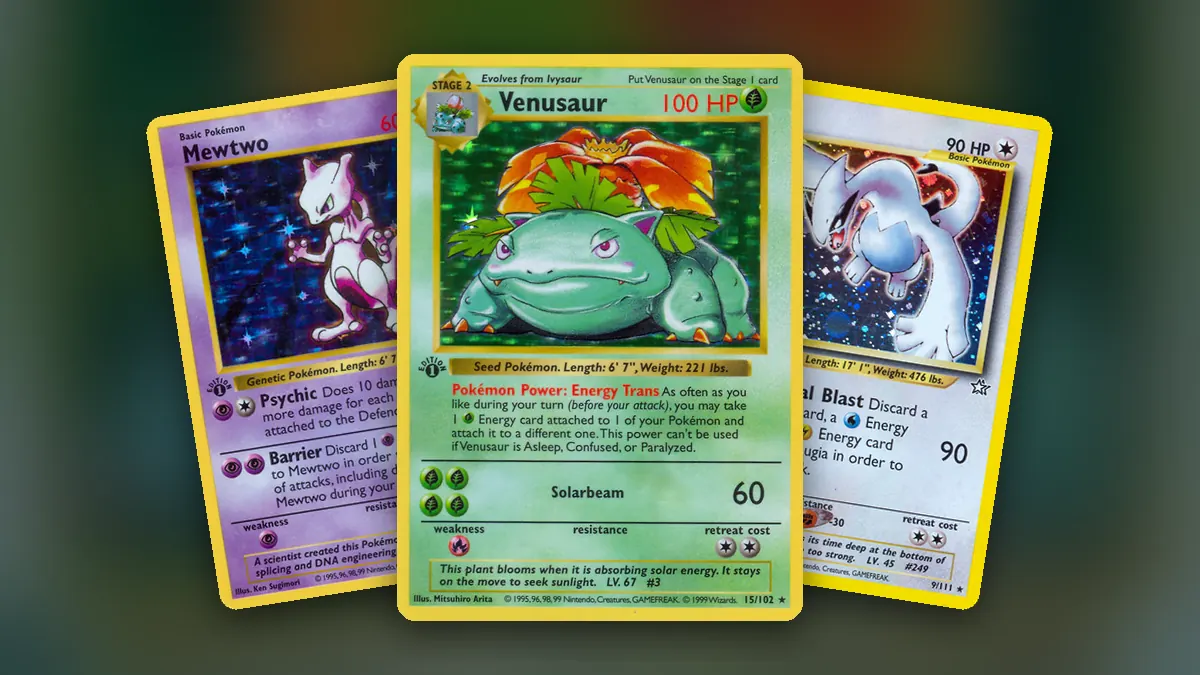
How to tell if a Pokémon card is fake
Put the card next to a real one, or an official scan, and check the text first. Look for a missing accent on "Pokémon", the wrong font or spacing, off-center energy symbols and a missing or wrong copyright line. Then check the feel and the back: fakes tend to be glossy, and their backs often print a lighter or purplish blue. The light test only catches thin, cheap fakes. For graded cards, a matching cert number is a starting point, not proof. If you bought a fake on eBay, open a return straight away, because if the seller doesn't accept returns, you have only 3 calendar days after delivery to request one.
Start with a card you know is real
Every check below works by comparison. The best reference is a genuine copy of the same card in your hand. The next best is a clear image of it. Wargamer suggests checking against a scan from Pokémon's official card database, and you can also pull up any card on our site: search a name, such as Charizard, then open the card page, for example Base Set Charizard 4/102, to see a full-size scan beside the price. Match the set symbol, collector number, rarity mark, attack names and damage numbers one by one.
Fakes are common enough that shops see them all the time. A Wisconsin card shop employee told InvestigateTV in February 2026, "Probably once a week I get a fake card," and added that "the majority of people who end up with fake cards are kids."
The checks at a glance
| Check | Genuine card | Common fake |
|---|---|---|
| Accent and spelling | "Pokémon" with the é everywhere, including the copyright line | Missing accent, typos, wrong Pokémon in the attack text |
| Font and spacing | Even, consistent typeface | Wrong font, wide or uneven letter spacing |
| Energy symbols | Centered icon of consistent size | Icon too large, off-center or the wrong color |
| Size | 2.5 × 3.5 inches (63 × 88 mm) | Slightly off, or uneven borders |
| Surface | Smooth, matte finish; real texture on textured cards | Glossy; texture printed flat or missing |
| Back | Darker blue mottling in the light sweep beside the Poké Ball | Solid, washed-out or purplish blue; sometimes a shiny back |
| Edition mark | 1st Edition or Unlimited only | "2nd Edition" or other editions that never existed |
Text, font, energy symbols and the copyright line
Text errors are the fastest giveaway and the easiest to overlook. Cardmarket calls a missing accent on "Pokémon" a "dead giveaway". JustInBasil's guide notes it most often goes missing in the copyright section at the bottom of the card. Check the name, HP and attack text for typos too, and make sure the attack text names the right Pokémon. Copied text from another card is a common slip.
Next, the font. JustInBasil says the kerning, or letter spacing, on fakes "is abnormally large and is usually inconsistent," and letters like g, y and j may hang lower than they should. Our font check guide shows what to look for.
Energy symbols are harder to fake than they look. Wargamer and Cardmarket both say counterfeit energy icons tend to be the wrong size, sit off-center or use the wrong color. Last, check the bottom edge. Genuine cards print a year and copyright line there. Cardmarket points out that Pokémon USA Inc. hasn't existed since 2009, so a newer card that names it is fake. Pokémon also has only 1st Edition and Unlimited printings, never a "2nd Edition". Vintage buyers should also read our guide to fake 1st Edition stamps.
Card stock, the light test and the black core
Real cards are built in layers. Wargamer describes "a reinforcing black layer, sandwiched between two white card layers." Cheap fakes often skip it, so a phone flashlight behind the card shows a bright spot that a real card blocks. The test has limits, though. Wargamer warns that "modern fakes are generally not thin enough for the light test to be conclusive," and different holo finishes let through different amounts of light. Compare against a real card from the same era under the same light. More on this in our light test guide.
Don't do the rip test. Tearing a corner to look for the black layer destroys the card, real or not. Wargamer calls it "very, very stupid", and our rip test explainer goes into more detail.
Feel is more reliable. Genuine cards have a smooth, matte finish, while fakes tend to be glossy, and Cardmarket's examples show the glare. Size matters as well: real cards measure 2.5 by 3.5 inches. Wargamer notes that real cards weigh 1.8 to 2 grams, but most modern fakes get the weight about right, so a scale adds little.
Holo pattern and the back
Modern chase cards are hard to copy well. JustInBasil says fake chase cards from XY onward "tend to have a very simple almost flat holo," and that "the worst fakes will print the texture" instead of pressing it into the card. Tilt the card under a light. On a real textured card, the holo shifts across the raised pattern. A printed pattern just shines flat. Fake full arts and EX, GX or V cards may also have a slightly shiny back.
Wargamer calls the back "an important red flag for fakes that you should always check." Look at the light blue sweep up and to the right of the Poké Ball. On a real card it is "dappled with the dark blue colour underneath". On most fakes it is a solid or washed-out blue. Wargamer quotes the dealer The Card Bazaar saying "around 80% of counterfeits" can be caught by the wrong shade of blue on the back alone.
Fake graded slabs: the cert number isn't enough
Graded cards are now a target because buyers trust the label. In January 2026 a Manhattan federal jury convicted a Washington man in a scheme that put cards, including 1999 Venusaur and Charizard, in PSA-style cases with "fraudulent labels, barcodes and certification numbers," defrauding buyers of more than $2 million (KIRO 7). In November 2026, Dexerto reported AliExpress listings for custom PSA-style labels at about $4.05 with more than 5,000 sales, some printed with real cert numbers. Dexerto also cites PSA's 2025 fraud report, which named Pokémon as PSA's most counterfeited category, with counterfeit Pokémon submissions up 125% year over year.
So run the lookup, then go further:
- PSA: enter the number on PSA's cert verification page. Then compare the card in the slab with PSA's own images and inspect the case for signs of tampering, as PSA advises (via Dexerto). A copied label with a real number will still pass the lookup.
- CGC: CGC's cert verification lets you see "images of the holdered card taken by CGC Cards". You can also scan the QR code on the back of the label. Check that the corners, centering and print marks in CGC's photos match the card in front of you.
- The case itself: look closely at the seams and the label for any sign the case has been opened. Genuine labels removed from their cases have been sold in Japan, so a real label doesn't prove the card behind it is the one that was graded.
Sealed scams: too cheap, resealed and weighed
Too cheap. JustInBasil puts it simply: "You aren't going to be picking up a new, authentic and unopened booster box for $10." Watch for listing words like "flash cards" or "authentic reproduction". Check recent sold prices on eBay or TCGplayer before you buy, and treat anything far below them with suspicion.
Resealed or fake boxes. Cardmarket says The Pokémon Company never seals a box with more than one stitch along the side. It also notes that packs in a real box always face front-to-back, not side to side, and that heat bubbles near the seal point to cheap plastic. Real packaging carries a Poké Ball watermark with a copyright symbol, which fakes often leave out.
Weighed packs. In vintage sets, packs with a holo tend to weigh slightly more, so loose packs can be sorted on a scale. Loose Packs, a vintage pack dealer, openly labels the heaviest third of each box "Heavy" and reports the gap is "usually a few tenths of a gram," with some sets overlapping entirely. A loose pack sold without any label may already have been searched this way. Loose vintage packs from an unknown seller are the riskiest sealed buy. Pay up for a sealed box from a trusted source, or buy the single you want.
If you already bought a fake
- eBay: the eBay Money Back Guarantee covers items that don't match the listing. When there are strong signs the item is counterfeit, you may not have to ship it back, but you must help eBay make sure it gets disposed of properly. Speed matters for cards. If the seller doesn't accept returns, eBay's policy gives trading cards only 3 calendar days after delivery to request one. If the seller doesn't respond within 3 business days, ask eBay to step in. For cards selling for $200 or more, look for the Authenticity Guarantee badge: those cards go to an authenticator before they reach you.
- PayPal: if you paid with PayPal outside eBay, open a dispute under PayPal's Purchase Protection program as soon as you spot the problem, and check that page for what qualifies and the current deadline.
- Keep evidence: keep the listing, messages and clear photos of the card next to a real one or an official scan. A local game store can give a quick second opinion.
- Report it: in the US, counterfeits can be reported to the National Intellectual Property Rights Coordination Center at iprcenter.gov.
For the bigger picture on grading delays and fraud risk, see our PSA backlog and card safety guide. Before your next purchase, run through our buying checklist.
Frequently asked questions
What is the easiest way to tell if a Pokémon card is fake?
Compare it with a real copy or an official scan and read the text. A missing accent on Pokémon, a wrong font, off-center energy symbols or a missing copyright line catch most fakes. Then check the back: on a real card the light blue sweep next to the Poké Ball is mottled with darker blue.
Does the flashlight test prove a card is real?
No. Real cards have a black core layer that blocks most light, so thin fakes glow under a phone flashlight. But many modern fakes are thick enough to pass, and different holo finishes react differently, so use it only alongside other checks.
Can a PSA slab be fake even if the cert number checks out?
Yes. Counterfeiters copy real cert numbers from public records onto fake labels. After the lookup, compare the card in the slab with PSA's own images, inspect the case for tampering and buy from trusted sellers.
How long do I have to report a fake card on eBay?
Under the eBay Money Back Guarantee, a buyer usually has 30 calendar days after delivery, or the seller's return window if longer, for items that don't match the listing. For trading cards from sellers who don't accept returns, the window is 3 calendar days after delivery, so act at once.
Is it safe to buy loose vintage booster packs?
It is the riskiest way to buy sealed product. Packs can be sorted by weight, since in older sets the heavier ones were more likely to hold a holo, and loose packs can also be resealed. Buy sealed boxes from trusted sellers, or buy the single card you want.
Sources
- Wargamer: How to identify fake Pokémon cards updated Jan 31, 2025; read Nov 27, 2026
- Cardmarket Help: Spotting a counterfeit read Nov 27, 2026
- JustInBasil: Identifying fake Pokémon cards read Nov 27, 2026
- InvestigateTV via Live 5 News: Expert shows how to spot counterfeit trading cards Feb 20, 2026
- Dexerto: Collectors fear fake PSA slabs after AliExpress sells custom labels Nov 10, 2026
- KIRO 7: Man convicted in $2M fake card grading scheme involving Pokémon cards Jan 29, 2026
- PSA: Cert verification official lookup tool
- CGC Cards: Verify CGC certification official lookup tool; read Nov 27, 2026
- eBay: Money Back Guarantee policy read Nov 27, 2026
- eBay: Return an item for a refund read Nov 27, 2026
- eBay: Authenticity Guarantee eligibility read Nov 27, 2026
- PayPal: Purchase Protection program official policy page; check current terms
- Loose Packs: Pokémon pack weight guide (a vintage pack seller) read Nov 27, 2026
Prices and figures are as reported by the sources on the dates shown and change daily by marketplace, condition and printing. This is collector information, not financial advice. See how we source prices and our editorial policy.